

Discover unique facts about Yemen’s Socotra Island, from exotic flora to ancient history that make it an interesting and mysterious destination.
Socotra Island, located in the Arabian Sea and part of Yemen, is known as one of the most unique places in the world.
With its extraordinary biodiversity and rich history, it is often referred to as the “mysterious island” full of extraordinary charm. Here are 10 unique facts about Socotra Island that you should know.
1. Dragon Blood Tree
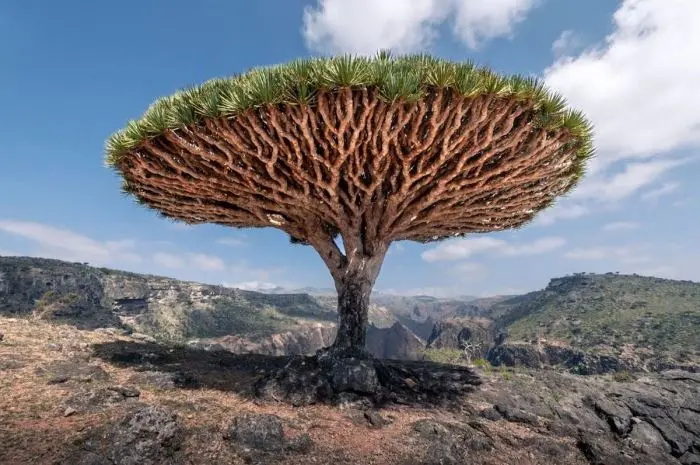
The dragon’s blood tree is an iconic symbol of Socotra Island, resembling a giant mushroom with umbrella-shaped leaves. This tree produces a red sap that was known in ancient times as “dragon’s blood.”
The sap is highly valuable and is used for a variety of purposes, such as a primary ingredient for paints and varnishes. In addition, this sap is also used in traditional medicinal practices.
The dragon’s blood tree can only be found on Socotra Island and some surrounding areas, making it one of the rarest flora in the world.
2. Inhabitants of Socotra Island
The population of Socotra Island has diverse backgrounds, with the majority being of Indian, Somali and African-American origin.
This island is rarely visited by tourists, so the local people depend on agriculture, fishing and animal husbandry for their livelihood. In addition, they also plant date palms which are found in abundance in this area.
Even though the island is still isolated, the people are very friendly and known for their hospitality, which makes anyone who visits feel warmly welcomed.
They maintain traditions and a simple life far from the hustle and bustle of the outside world.
3. Various Species of Flora and Fauna
Socotra Island has more than 800 plant species, and more than a third of them are endemic species that only exist on this island. This unique biodiversity makes Socotra one of the world’s biodiversity hotspots.
Apart from flora, the fauna on this island is also very diverse. There are about 34 species of reptiles, 96 species of land snails, and more than 730 species of fish.
Most of these species are endemic, meaning they are found only on Socotra. The island is also home to around 192 species of birds, some of which are very rare and endangered.
4. Origin of the Name Socotra
The name “Socotra” has several theories of its origin. One is that it is derived from Arabic, meaning “dragon’s blood market,” referring to the red resin produced by the dragon’s blood tree.
Other historians argue that the name comes from a Sanskrit word meaning “island of happiness.” Regardless of its origin, the name Socotra has become firmly attached to the island, reflecting its rich cultural and natural heritage.
5. Officially a UNESCO World Heritage Site
In 2008, Socotra Island was recognized by UNESCO as a World Heritage Site, which shows how important the island is in terms of its biodiversity and ecosystem.
With this status, Socotra receives international protection to maintain the diversity of its endemic species.
The diversity of flora and fauna found here is seriously threatened, especially by climate change and exploitation of natural resources, so its status as a world heritage site helps protect its natural beauty.
6. Ancient Trading Center
Despite its isolation and remoteness, Socotra Island has a long history as an ancient trading center. Since the time of the Romans, Greeks, and ancient Egyptians, Socotra has been an important trade route for various valuable goods.
One of the main commodities traded was the red resin from the dragon’s blood tree, which was used for dyeing, varnishing, and medicine.
In addition, the frankincense produced in Socotra was also very famous and was sold to various parts of the world in ancient times. These trading cities made Socotra a major hub on trade routes in the Arabian Sea.
7. Discovery of Ancient City
In 2010, Russian archaeologists discovered the ruins of an ancient city on Socotra Island that revealed the island’s long history of human civilization.
The discovery included ancient caves and shipwrecks that indicated past trade activities. These sites provide a fascinating insight into how Socotra was once a meeting place for many cultures.
This discovery further enriches the island’s historical story and adds to the appeal for tourists interested in archaeology and ancient history.
8. Socotra Island Industry
The main industries that develop on Socotra Island include agriculture, fishing, and date palm cultivation. Local people are also renowned for their skills in collecting pearls and harvesting other marine products.
However, in recent years, the ecotourism industry has become increasingly popular in Socotra. This island attracts tourists who want to enjoy its natural beauty, with various exciting activities such as diving, fishing, sailing, and mountain climbing.
The untouched natural beauty makes Socotra an increasingly attractive tourist destination for adventurers.
9. Diversity of Marine Ecosystems
Apart from the beauty of its land, Socotra is also famous for the diversity of its marine ecosystem. The sea around the island is home to various species of fish, coral reefs and other marine organisms that have not been exposed to much human activity.
This makes Socotra one of the best locations for diving and exploring the underwater world which is still very natural. Tourists can enjoy spectacular underwater views with various species of colorful fish and coral.
10. Potential as an Exclusive Tourist Destination
Socotra Island remains relatively untouched by mass tourism, making it an ideal place for those seeking a different and more exclusive travel experience.
Although access to the island is quite limited, this only makes it more attractive to travelers who want to enjoy the tranquility and natural beauty that is not found in many other places.
With the support of the local government and environmental conservation efforts, Socotra has the potential to become one of the leading tourist destinations in the future, combining natural beauty, history and unique culture.
Socotra Island is a hidden gem that offers an incredible variety of natural and historical wonders. The uniqueness of its flora and fauna, coupled with its long history, makes this island a must-visit for nature and adventure lovers.
As a less-explored tourist destination, Easter Island offers an unforgettable experience for anyone who wants to explore its pristine natural beauty and rich culture.